China Top 10 Assembly Line Trolley Manufacturers
Assembly lines depend on more than machines. A well-designed Assembly Line Trolley can keep parts within reach, reduce unnecessary walking, and support a smoother flow between workstations. On a busy factory floor, details matter: wheel material affects noise, shelf spacing determines what fits, and handle height can shape daily comfort. Small choices, noticeable differences.
This guide to China’s top 10 Assembly Line Trolley manufacturers is intended to help buyers compare suppliers with practical questions in mind. It considers product range, customization options, load capacity, materials, manufacturing experience, and the clarity of technical information. These factors can indicate whether a supplier is suited to a particular operation, but they do not replace an independent assessment. A polished catalogue is not proof of consistent production quality.
Look closely. Ask for drawings, specifications, and details about testing and quality control. Where possible, compare samples or arrange a factory assessment before placing a large order. Confirm that stated capacities match your intended loads, floor conditions, and handling practices. Even a sturdy trolley may perform poorly if its dimensions or wheels do not suit the actual route.
No manufacturer is the right fit for every facility. Supplier information can also change over time, and published claims may be difficult to compare directly. Use this list as a starting point, not a final verdict. Careful verification often takes longer than expected, and that is worth acknowledging.
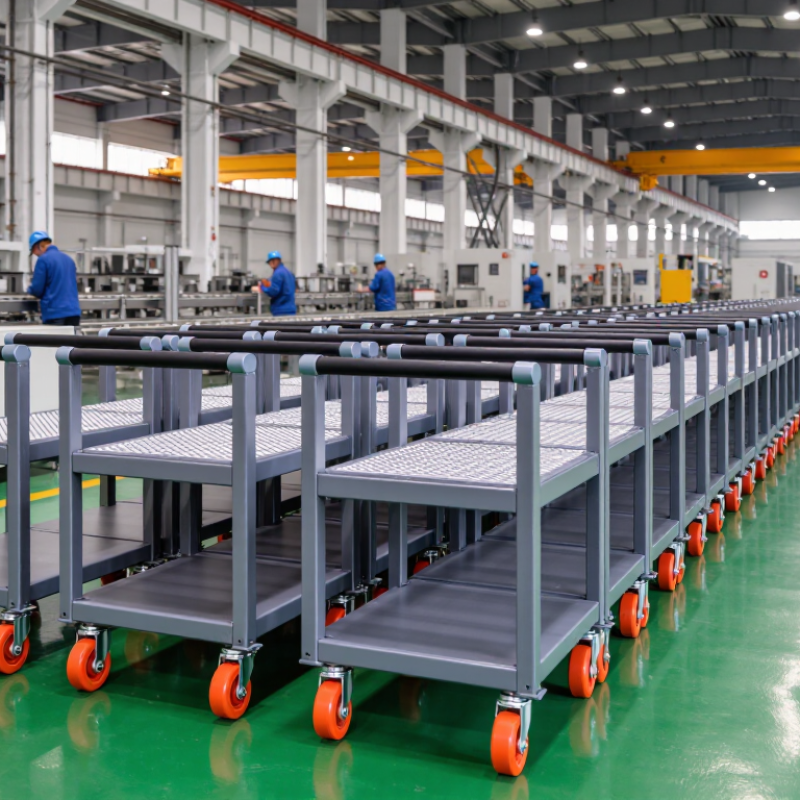
What Assembly Line Trolleys Are and How They Support Production
An assembly line trolley is a mobile carrier used to move parts, tools, or finished components between workstations. It may have shelves, bins, drawers, or a frame built around a specific load. On a production floor, the right trolley keeps frequently used items close without filling the workbench. Less reaching. Fewer loose parts.
For example, a trolley beside a fastening station might hold labeled bins of screws, a torque tool, and a small tray for completed assemblies. Workers can roll it to a nearby cell when the production mix changes. Wheels with reliable brakes help keep it steady during loading, while rounded edges and clear load limits reduce everyday handling risks. These details matter more than a polished appearance.
Trolleys also support replenishment routines. A material handler can bring a prepared load to a workstation and take empty containers away on the return trip. This can reduce unnecessary walking, but only when routes stay clear and supplies are arranged consistently. A trolley that is too wide may block an aisle; one with poor handles can be awkward to steer. Still, mobility is not a cure-all. Teams should check wheel condition, shelf stability, and actual load weight, then adjust the layout when the trolley makes work harder rather than easier.
How to Evaluate Assembly Line Trolley Manufacturers in China
When evaluating assembly line trolley manufacturers in China, inspect the trolley in motion, not only in a catalog. Ask for rated load capacity, platform dimensions, wheel material, turning radius, and braking details. Then compare these figures with your aisle width, floor joints, and actual parts. A 500-kilogram rating means little if the trolley flexes under an uneven load. Look closely at welds, handle joints, and wheel mounts. Small defects matter.
Deloitte and MAPI’s 2024 Smart Manufacturing Survey found that 86% of manufacturing executives expect smart factory solutions to drive competitiveness within five years. That figure is not a trolley quality score. It does, however, highlight why equipment should fit real production workflows. Ask whether the manufacturer can provide drawings, load-test records, spare-wheel lead times, and a sample unit for a floor trial. Test it with your heaviest usual load. Watch how it moves over floor seams. No supplier is perfect. A polished test area can hide rough daily conditions, so repeat the trial on your own line. Check coating thickness and weld consistency across several units, not just one sample. Also clarify customization costs and replacement-part availability in writing.
Profiles of 10 Chinese Assembly Line Trolley Manufacturers
Profiles of ten Chinese assembly-line trolley manufacturers are most useful when they show engineering choices, not just catalog dimensions. Compare makers of welded-steel carts, modular-pipe trolleys, gravity-roller units, and line-side kitting carts. Other profiles may focus on heavy-load frames, adjustable shelves, towable trains, compact workstations, or electrostatic-control applications. Details matter. Ask about rated capacity, wheel material, turning radius, and shelf adjustment. A trolley that fits a drawing may still block an aisle when fully loaded.
MHI’s 2024 Annual Industry Report says 55% of surveyed supply-chain professionals planned to increase technology investment. That figure signals continued attention to operational efficiency, but it does not prove that any trolley improves productivity. For each manufacturer profile, check weld quality, load-test documentation, finish consistency, and spare-wheel availability. Request a sample or factory acceptance test when practical. Published specifications can be incomplete; even capable suppliers may describe load limits differently.
Tips: Compare quotations using the same load, aisle width, and shift conditions. Test it loaded. Check whether handles, brakes, and shelves remain usable during repeated turns. Record delivery time and customization limits, too. These details are easy to overlook, and a neat comparison table will not capture every shop-floor problem.
How to Compare Suppliers for Quality, Customization, and Service
When comparing China’s top 10 assembly line trolley manufacturers, assess the trolley in your actual workflow, not just its catalog. MHI’s 2024 Annual Industry Report found that 55% of surveyed supply-chain professionals planned to increase technology investment. That figure is not trolley-specific, but it highlights the value of equipment that fits changing operations. Ask suppliers for load-capacity test records, wheel material details, weld inspection methods, and clear warranty terms. Check a sample on your own floor: a loaded trolley should turn smoothly through the tightest aisle without rattling or shifting its bins.
Customization matters. Share a simple layout with shelf spacing, handle height, payload, and floor conditions. Request a drawing before production and confirm how design changes affect lead time and price. Service is equally practical: ask about spare-wheel availability, response times, and support after delivery. A low quote can hide costs if replacement parts take weeks to arrive. One limitation: supplier-provided test data may not reflect your site conditions, so verify critical details independently.
Tips: Compare the same specification across suppliers. Photograph sample trolleys in use, record turning effort, and check for sharp edges or loose fasteners. Keep it simple. Then ask each supplier to explain one likely failure point and how they would address it. A vague answer is worth noting.

