Why Choose Laser Equipment for Your Business?
Laser Equipment can help a business cut, mark, weld, or engrave with repeatable precision. For a manufacturer, that may mean cleaner edges on sheet metal, legible codes on packaging, or fewer setup changes between jobs. The opportunity is real, but the right machine depends on the material, throughput, operator skill, and service support—not just the advertised wattage.
Fortune Business Insights estimated the global laser technology market at USD 18.7 billion in 2023 and projected growth to USD 35.1 billion by 2032. This broad market estimate signals expanding interest, not guaranteed returns for any buyer. That matters. A laser can improve a process, but it can also expose weak workflows or sit underused when specifications do not match daily production.
Laser pioneer Theodore Maiman is often credited with the quip, “The laser is a solution looking for a problem.” The line is a useful caution, though its attribution is not consistently documented. Start with the part. Measure current cycle times, scrap, changeovers, and labor demands. Then compare equipment against those specific needs, including installation, training, maintenance, and consumables. A supplier’s demonstration on your actual material is more useful than a polished brochure. This guide explores where Laser Equipment can create practical value, what to assess before investing, and which questions deserve a careful second look.
Define Laser Equipment: Four Core Industrial Processes and Their Uses
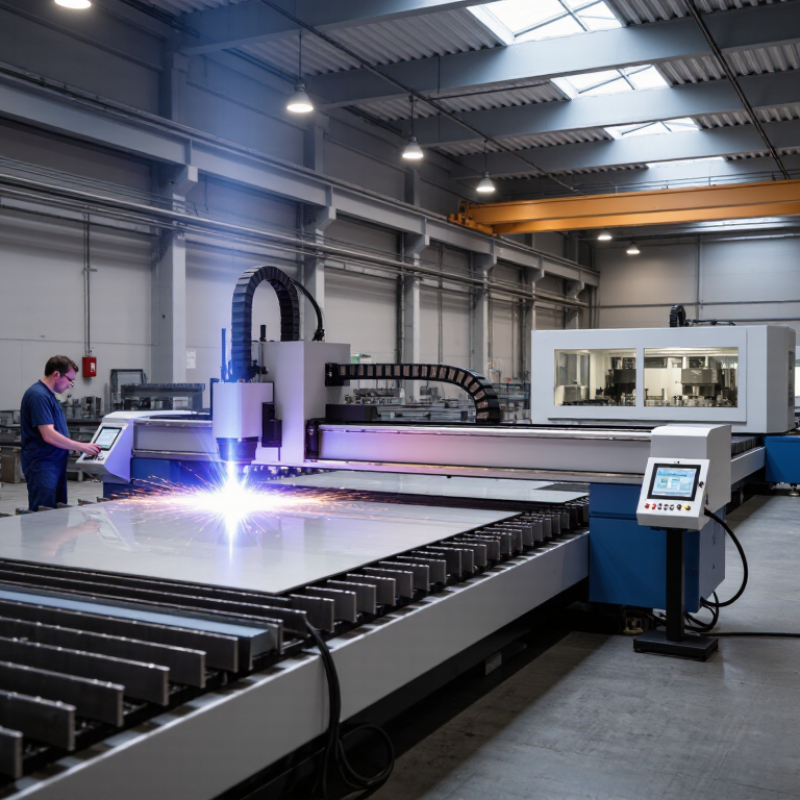
Industrial laser equipment uses a concentrated beam to change material without a conventional cutting tool. Four common processes are cutting, welding, marking, and surface cleaning. Each suits different production tasks.
Laser cutting melts or vaporizes material along a programmed path. On a shop floor, it can produce sheet-metal brackets with narrow kerfs and little tool wear. Laser welding joins parts by melting their edges, useful for thin assemblies and precise seams. Heat distortion can still occur. That distinction matters.
Marking adds text, codes, or patterns by altering a surface, often without removing much material. Cleaning removes rust, paint, or oxide layers through controlled ablation. It can reduce chemical use, but settings need testing on each substrate. Clean, but not magic. The International Federation of Robotics’ World Robotics 2024 report recorded 541,302 industrial robot installations worldwide in 2023. That growth reflects wider factory automation, though it does not guarantee a laser cell will pay off. Buyers should compare cycle time, material thickness, extraction needs, and operator training. A short production trial often reveals issues a specification sheet misses. The awkward part is that the “best” process may change with each job.
Why Choose Laser Equipment for Your Business? - Define Laser Equipment: Four Core Industrial Processes and Their Uses
| Industrial Process | What the Laser Does | Common Materials | Typical Business Uses | Key Considerations |
| Laser Cutting | Focuses a high-energy beam to melt, burn, or vaporize material along a programmed path; assist gas may help clear the cut. | Commonly used with sheet metals, plastics, wood, textiles, and paper, depending on the laser type and material. | Sheet-metal parts, machine panels, signage, packaging components, and custom-cut prototypes. | Cut quality and achievable thickness depend on the laser source, material, power, optics, and assist gas. Some materials can release hazardous fumes and require suitable extraction. |
| Laser Welding | Heats a small, localized area to join parts by melting material at the joint, often producing a narrow weld zone. | Metals such as stainless steel, carbon steel, aluminum, and some alloys, subject to process setup and joint design. | Joining components in automotive, appliance, electronics, medical-device, and general metal fabrication workflows. | Joint fit-up, material reflectivity, thickness, and heat sensitivity affect results. Appropriate shielding, process control, and laser safety measures are essential. |
| Laser Marking and Engraving | Alters a surface to create a visible mark; marking may change color or texture, while engraving removes material to form a recess. | Metals, many plastics, ceramics, glass, and coated or painted surfaces, depending on wavelength and material response. | Serial numbers, barcodes, logos, traceability codes, product labels, and decorative designs. | Mark contrast and durability depend on the substrate and process. Test samples are recommended, especially for regulated identification or code readability. |
| Laser Cleaning | Uses controlled laser pulses or scanning to remove or loosen surface contaminants, coatings, or oxides with limited impact on the underlying substrate when properly set up. | Metal parts and selected other surfaces, depending on the contaminant, substrate, laser settings, and cleaning method. | Rust or oxide removal, surface preparation before joining or coating, and cleaning of tools, molds, or components. | Results vary with contamination and surface condition. Removed material can create particles or fumes, so enclosure, extraction, and process validation may be needed. |
Practical note: Laser equipment can support repeatable, programmable processing, but suitability depends on the material, part design, production volume, required quality, safety controls, and total operating costs. Validate the process on representative samples before production.
Match Technology to the Job: Fiber, CO₂, and UV Laser Systems
Choosing a laser starts with the material and the finished part, not the machine’s advertised power. Fiber systems are commonly used for marking and processing metals, such as stainless-steel tools or aluminum nameplates. They can also work with some plastics, but results depend on the material and its additives. Test the exact grade before planning production.
CO₂ systems are often suited to non-metal materials, including wood, acrylic, paper, and some textiles. A workshop making engraved wooden panels may value a clean edge and a generous working area. UV systems can mark certain plastics, glass, and coated surfaces with less heat impact than some alternatives. That can help protect fine details, though outcomes still vary by surface and setup. Small details matter.
It is tempting to choose by speed alone. Yet a fast machine may still create bottlenecks if parts need careful fixturing, frequent cleaning, or extra finishing. Test real parts. Compare mark contrast, edge quality, cycle time, and repeatability across several samples. Keep notes on settings and material batches; small variations can change the result. Also account for extraction, operator training, and maintenance when comparing systems. A simple sample test is useful, but it may not represent a full shift.
Compare Energy Efficiency: Fiber Lasers Can Reach 50% Wall-Plug Efficiency (IPG)
Why Choose Laser Equipment for Your Business?
Wall-plug efficiency measures how much electrical input becomes laser light. Advanced fiber-laser specifications report figures as high as 50%, but this is an upper-end benchmark, not a guarantee for every machine. At that rate, a 10 kW laser output needs roughly 20 kW of electricity at the source, before adding chillers, extraction, and other equipment. Jauregui, Limpert, and Tünnermann’s review in Nature Photonics (2013) discusses fiber lasers’ efficiency and scalability. Real operating costs still depend on material, cutting speed, maintenance, and daily workload.
That distinction matters on the factory floor. A laser that runs short shifts may not deliver the same savings as one used steadily. Track the machine’s power draw during actual jobs, including standby periods. Compare kilowatt-hours per finished part, not just the laser’s rated efficiency. The number can be humbling. It may also reveal avoidable idle time.
Tips: Ask suppliers for measured power consumption at your typical settings. Include cooling and extraction loads, then test with your own material and part mix.
Review Safety Standards: IEC 60825-1 Defines Laser Classes 1–4
Why Choose Laser Equipment for Your Business?
Choosing laser equipment starts with understanding its hazard class, not just its speed or output. IEC 60825-1 classifies lasers from Class 1 to Class 4 according to accessible radiation and operating conditions.
Class 1 is considered safe during reasonably foreseeable use, though a service panel may expose a stronger internal beam.
Class 2 covers visible-light lasers and relies partly on natural aversion responses, such as blinking.
Class 3R can present eye risk from direct viewing.
Class 3B can injure eyes from direct beams, while Class 4 can also create skin and fire hazards.
Diffuse reflections may still matter with Class 4. That detail is easy to overlook.
For a business, the class helps guide installation, access controls, training, and protective measures. Check the equipment label and manufacturer’s safety documentation, then assess the actual workspace and task. A classification alone does not replace a site-specific risk assessment.
Higher-class systems may need enclosed beam paths, interlocks, warning signs, and suitable eyewear. Requirements vary with wavelength and exposure conditions. It can feel like extra work, but guessing is worse.
Tips: Keep beam paths below or above eye level where practical. Never rely on eyewear alone; verify its rating matches the laser’s wavelength and use.
Assess Business Value: Compare Cycle Time, Uptime, and Payback with Trial Data
Why Choose Laser Equipment for Your Business?
A laser purchase should be judged on shop-floor evidence, not brochure speed. Record current cycle time, good-part output, changeover delays, and unplanned stops before testing. Then run the same representative jobs on the laser, using identical material, tolerances, and staffing. Measure the full shift, not one impressive cut. Small details matter: loading time, edge cleanup, and waiting for the next sheet can erase a fast processing time.
Compare trial results with your baseline. Vorne’s OEE Industry Benchmark describes 85% OEE as a world-class reference, based on 90% availability, 95% performance, and 99.9% quality. Treat that as broad manufacturing context, not a laser-specific promise. Track uptime alongside cycle time, scrap, and rework; a machine that runs quickly but needs frequent adjustment may produce little extra saleable output. Keep the data. Also note where the trial differs from normal production.
Estimate payback using verified gains: additional good parts multiplied by realistic contribution margin, plus documented labor or outsourcing savings. Divide the equipment’s installed cost by that monthly benefit. Include service, consumables, training, and financing costs. One uncomfortable truth: trial conditions can flatter any machine. Repeat the test across different operators and job types, and check whether the assumed demand actually exists.

